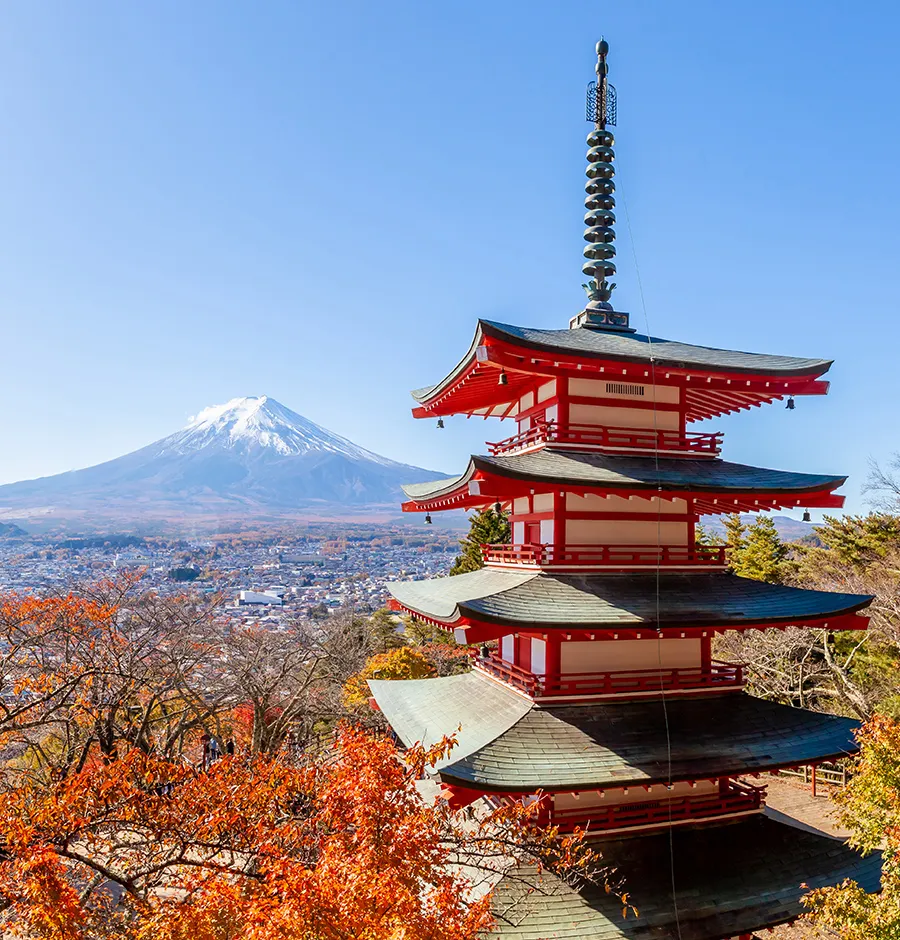
At the Fuji Sanroku (foot of Mt. Fuji) where the Kawaguchiko Onsenji Yumedono stands, there are many hiking courses along with some wonderful views of Mt. Fuji and the lakes.
A course which begins at the five lakes of Mt. Fuji, this nature trail includes the Gokodai (where there is a 360-degree panoramic view of Mt. Fuji), the Sankodai with a whole view of the Aokigahara Jyukai (thick forest), the lava cave which is the leading sightseeing spot of the Fuji Sanroku, the Narusawa Ice Cave and finally the Narusawa Wind Cave.
- Access -
Kawaguchiko St. - (to Shinfuji St. or Motosuko or Shimobe Onsenkyo - 15mins by bus) - Ippongi
- Hiking Course -
Wind Cave - (to Kawaguchiko St. or Fujiyoshida St. - 20mins by bus) - Kawaguchiko St.
Recommended for a good walker, this course has some great views. It runs along the mountain ridge and provides a beautiful view of Mt. Fuji. There is also a useful route which leads down to Kawaguchiko St.
- Access -
Kawaguchiko St. - (to Kofu St. 20mins by bus) - Mitsutouge Mountain Climbing Entrance
- Hiking Course -
Kawaguchiko St.
This course possesses some commanding views of the South Alps, a virgin forest of northern Japanese hemlock, Veitch's silver fir and Japanese larch, which lies near the 5th stage of Mt. Fuji. Also of note are the rich natural gardens of Oniwa and Okuniwa.
- Access -
Kawaguchiko St. - (to 5th stage 60mins by bus) - 5th stage
- Hiking Course -
Okuniwa Parking Lot - (to Kawaguchiko St. 60mins by bus) - Kawaguchiko St.
A course to go halfway around Kawaguchiko (Lake Kawaguchi).
Starting from this hotel, cross the Kawaguchiko Oohashi (bridge) and stroll around the lakeside while enjoying the view of Mt. Fuji.
Outdoor sports, an amusement park and other activities can be enjoyed around Kawaguchiko.
Details:http://www.fujisan.ne.jp/spot/index_e.php
Fuji Onshitsu Asama Shrine (Satomiya, Honden)
Made by Fujiwara Yoshitada in 699, this is believed to be Mt. Fuji's oldest shrine.
Motosuyama Shrine
Stands near Motosuko. The main shrine was built in 1781 and the outer shrine was constructed in 1806.
Kawaguchi Asama Shrine
Established in 865. The "Magomi Festival" (which is dedicated to Chigo no Mai) is held on 25th April.
There is also the "Daidai Shin Festival" which is held on 28th July, as well as seven Japanese cedars in the precincts which stand as a natural prefectural monument.
Suitengu, Mitama Koutsu Shrine
Guarding water and children, the shrine is a potent charm for agriculture, fishing, maritime transport, safe births, and healthy child rearing.
It also protects against water-related accidents such as drowning.
Ooishi Gokoku Shrine and Nitigetsu Shrine
A shrine to console the spirits of fallen solders.
This little-known space (which also functions as a park) has a great view of Kawaguchiko.
Kifune Shrine
Adjacent to the Kamogawa river, this shrine is a means by which to worship the god of water.
Ooishi Shrine
There is a huge stone here, from which the name "Ooishi" originates.
The shrine's arrangement of huge stones makes it the only one of it's kind in Yamanashi prefecture.
Shojinko Suwa Shrine
The main shrine is one-room structure rebuilt in 1843.
The chief characteristic of this construction are the ornamental carvings which run all around the shrine.
Their subject matter varies from animals and plants to events in Chinese history.
Myouhou Temple
Constructed in 1278, this temple possesses cultural properties such as "Myouhou Dera Ki" which is a valuable record for historians.
Kawaguchiko Suwa Shrine
Positioned along the prefectural road, Kawaguchiko Suwa Shrine is famous for it's huge Japanese cedar.
Hachioji Shrine
The main shrine worships the "Susanou no Mikoto" and "Hachioji" (5 gods and 3 goddesses) and was established in 1186.
Tsutsuguchi Shrine
Established in 1193, this shrine was built to worship the god of water.
Long ago, the place was called "Tsutsuguchi" and the water of Kawaguchiko was absorbed there.
Myouhon Temple
The resident of the village, called Sukeshirou, established the main temple in June, 1261.
Seno Umi Shrine
A shrine which stands in the Aokigahara Jyukai and links the Nishiko Guest House Village and the Ryugu Cave.